Free Consultation
 PCI-DSS Compliant
 GDPR Ready
 ISO 27001
 NDA Protected
 AI Services
 AI App Development
 Generative AI Development
 AI Chatbot Development
 AI Integration Services
 AI For Fintech
 AI Financial Assistant Solution
 AI Insurance Agent Development
 Tech Stack
 OpenAI / GPT-4
 Claude / Anthropic
 Gemini / Google AI
 Llama / Open Source
 LangChain / LlamaIndex
 Pinecone / Pgvector
 AWS / Azure AI


 Fintech Solution
 Core Fintech
 Fintech App Development
 Neobank App Development
 eWallet App Development
 Payment Integration
 Lending Software
 BNPL Solution
 BNPL App Development
 Insurance App
 Investment App Dev
 Wealth Management App
 Crypto & DeFi
 DeFi App Development
 Crypto Wallet Dev
 Crypto Exchange Dev
 Trading Platform Dev
 Payments
 Compliance
 RegTech App Dev
 Fraud Detection
 Lending Ecosystem
 P2P Lending Platform
 Mortgage Lending
 Engagement
 Outsourcing Dev


 Mobile Development
 Mobile App Dev
 iOS App Development
 Android App Development
 React Native
 Flutter Development
 Web Development
 Node.js Development
 React.js Development
 Angular Development
 PHP / Laravel
 App Services
 UI/UX Design
 App Maintenance
 By Stage
 MVP Development
 Industry Solutions
 Healthcare App Dev
 Education App Dev
 Travel App Dev
 Real Estate App Dev
 Logistics Software
 Social Media App


 Hire Mobile Developers
 Hire iPhone Developers
 Hire Android Developers
 Hire React Native Devs
 Hire Flutter Developers
 Hire Web Developers
 Hire Node.js Developers
 Hire Angular Developers
 Hire PHP Developers
 Hire Laravel Developers
 How It Works
 Pre-Vetted Developers
 Ready In 48 Hours
 NDA From Day One
 Replace Guarantee

 Company
 About Us
 Portfolio
 Case Studies
 Blog / Insights
 Careers
 Contact Us
 Recognition


 Offices




| Quick answer: A closed-loop payment system is a payment method that only works within one company’s ecosystem, like a Starbucks gift card or a game-zone card, instead of across different banks or merchants. |
TL;DR
- Unlike an open-loop card that works anywhere on a network like Visa, a closed-loop balance can only be spent with the one business that issued it.
- Businesses build closed-loop payment systems to reduce transaction costs, control payment flow, and keep users active within their own ecosystem.
- Closed-loop payment system development improves customer experience by offering faster payments, rewards, stored value wallets, refunds, and easy repeat purchases.
- To create a closed-loop payment platform, you need a safe wallet setup, balance management, user accounts, transaction tracking, and compliance with payment rules.
- The development cost of a closed-loop system depends on security needs, system size, number of users, and features.
- Nimble AppGenie has delivered 350+ closed-loop and eWallet builds – scoping each against the client’s compliance requirements, POS infrastructure, and loyalty goals before development begins.
It’s super easy to make payments thanks to the latest technological advancements. Back then, people carried physical cash and change to pay for things; today they pay with just a tap on their smartphone.
This has been made possible by various payment methods and systems. One such system is closed-loop payments.
Closed-loop payment systems are used in various industries, especially for daily expenses at retail stores, coffee shops, hotels, etc. The ease of payments and the security they offer to businesses are unmatched.
Nimble AppGenie’s experts created this guide to cover how closed-loop payment systems work, implementation steps, verified real-world examples, and the technology that makes them simple and secure.
What is a Closed-Loop Payment System?
A closed-loop payment system refers to a financial arrangement that works in a particular ecosystem, allowing the customer to pay for a certain service directly.
Unlike open-loop payment systems that work across multiple entities, closed-loop systems offer higher efficiency by allowing a user to use a dedicated pool of funds only in their confined ecosystem of services.
The best example of a closed-loop payment system can be found at game zones where people add funds to their game zone cards and pay for different games directly from them.
All the funds present in the cards can only be used in the game zone, creating a seamless experience for cardholders.
Another cool example of a fully functional closed-loop payment system can be seen at Starbucks. The availability of a dedicated digital wallet where consumers can add funds and directly use those funds at any Starbucks creates an optimized payment experience for all users.
You may be wondering how it is a good payment arrangement if it is limited to a single ecosystem. Well, it creates an opportunity for businesses to develop a loyal customer base.
The entire system matches the robustness of a financial framework. It offers comparable features like instant payment transfer, a personal account to deposit funds, etc. that are quite comparable to mobile banking app features.
Not to mention, customers get instant cashback, loyalty points, and other offers for using a closed-loop payment system dedicated to a service provider, making it a win-win for both users and the company.
This connects directly to how gamification drives engagement in eWallet apps, which closed-loop systems are built for.
Key Terms
- Closed-Loop System: Funds are tied to one specific issuer, and only they can spend them – no bank or external network involved in redemption.
- Open-Loop System: Funds move across different merchants or banks via a shared network like Mastercard, Visa, or an interbank rail; see our open-loop payment systems guide for a full breakdown.
- POS (Point of Sale): The hardware or software terminal where a transaction is initiated and processed.
- Stored Value: Money pre-loaded onto a card or wallet before it’s spent; can’t be drawn directly from a bank account at the time of purchase.
How Big Is the Closed-Loop Payment Market?
Closed-loop payment systems already represent a substantial part of the gift card and prepaid ecosystem, with recent data showcasing robust consumer adoption and continued growth.
- Closed-loop cards accounted for 61.75% of the US gift card and incentive card market in 2025. The overall market was valued at $207.09 billion in 2025 and is predicted to reach $220.38 billion in 2026, according to Mordor Intelligence.
- US consumers were projected to spend about $29 billion on gift cards during the 2025 holiday season, with 43% of shoppers planning to buy at least one gift card, per the National Retail Federation.
- Closed-loop gift card usage also showed robust momentum in 2025. InComm Payments’ survey of 6,500+ gift card shoppers found that spontaneous purchases among closed-loop gift card shoppers increased almost 30% annually, while the number of closed-loop shoppers who went online to find a specific gift card increased 20%.
- Starbucks offers a large-scale example of a brand-controlled payment and loyalty ecosystem. In Q1 FY2026, Starbucks Rewards hit 35.5 million 90-day active US members.
These figures show that closed-loop payments are already an essential part of the broader prepaid and gift card ecosystem. For businesses, the model can combine payments, loyalty, stored value, and customer engagement within a controlled brand ecosystem.
How Do Closed-Loop Payment Systems Work?
A closed-loop payment system processes transactions entirely within the issuer’s ledger – no external card network is involved in authorization or settlement. When a user taps a stored-value card or wallet, the issuer’s backend validates the balance directly and credits the merchant on the same system, typically in under 100ms.
To understand how a closed-loop payment system works, you must first understand what it is made of.
There are several components that, when combined, form a payment arrangement that can be used to implement a closed-loop payment system.
A closed-loop payment system is made up of the following components:
- User-Facing Application: A digital platform that offers users the ability to add funds, check offers, and balances, and pay for the services they opt for.
- Point of Sale Platform: The point of sale is a payment terminal for retailers/business owners to accept payments easily and process them.
- Backend System: The system also requires a backend system that can be used to check all the transactions and keep track of incoming and outgoing payments.
- Payment Methods: For any closed-loop payment system, it is necessary to have at least one or two payment methods. In some cases, it is a digital wallet, and in some, it is a physical card.
- Financial Infrastructure: Last but certainly not least, every closed-loop payment system requires a financial institution or a payment processor to enable the transactions. This infrastructure is what facilitates the transfer of funds.
Now, knowing the components involved in the system, you might have an idea about what closed-loop payments are all about.
Now, let’s take a look at all the steps involved in the entire process.
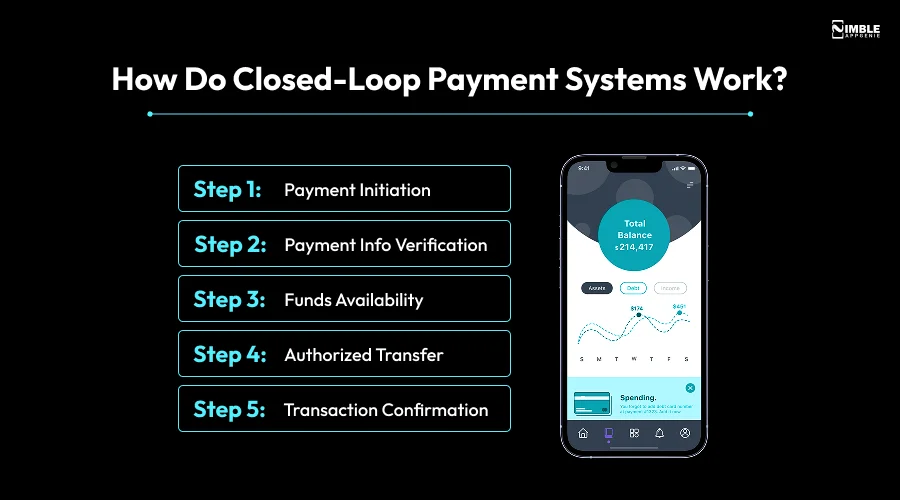
Step 1: Payment Initiation
In this step, the customer initiates a payment transaction through a secure transaction processing system to pay for the service using the payment method of their choice. They can use their e-wallet or physical card.
Step 2: Payment Info Verification
Once the customer initiates the payment process, the request is shared via the payment terminal used at the Point of Sale. This terminal checks the payment information of the customer. This information includes the name of the customer, account number, verification code, etc.
Step 3: Funds Availability
If all the information is verified, the backend system proceeds to check the balance of the customer to verify that the requested funds are available to finish the transaction.
Step 4: Authorized Transfer
Once both the payment information and fund status are verified, the transaction is authorized, and the transfer is completed.
Step 5: Transaction Confirmation
A receipt of the transaction is generated and shared with the customer to let them know that their payment has been completed.
All these steps happen in a matter of seconds, making the entire transaction feel seamless.
The best part about these transactions is that in a closed-loop payment system, all of these are highly secure and since the ecosystem for it is limited, it is free of any sort of fraudulent activity.
What Are Real-World Examples of Closed-Loop Payment Systems?
Any transaction where the payer and payee are part of the same single-issuer ecosystem is closed-loop. Some of the most common examples are:
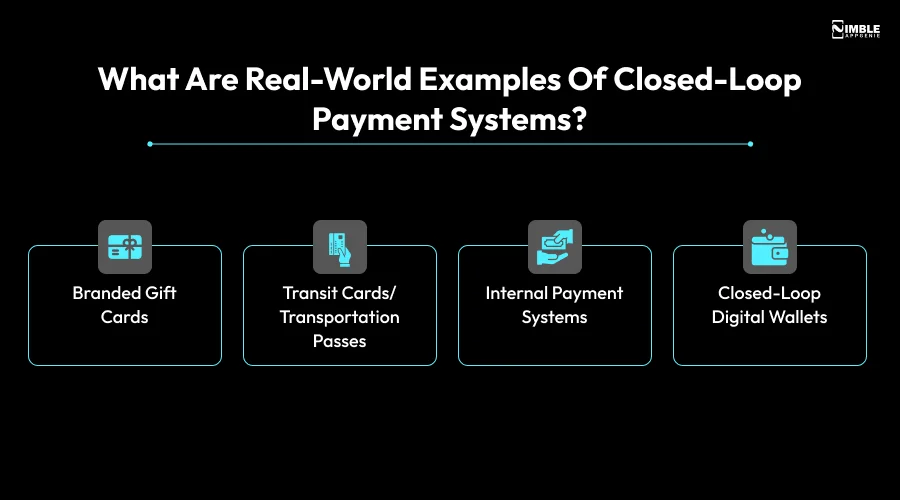
1. Branded Gift Cards
If you are a brand offering products or services, you can create your own gift card that people buy and use later as payment. The card works only for your products or services, making it a completely closed-loop system.
2. Transit Cards/Transportation Passes
Several cities have implemented transit cards for public transportation. These fall under closed-loop transactions, as funds added to the transit card can be used on public transit.
3. Internal Payment Systems
Many coffee outlets, game zones, and clubs issue a custom payment method, a membership card or registration that’s then funded to complete internal payments. The classic example is a game zone card, spendable only on games inside that play area.
4. Closed-Loop Digital Wallets
A type of eWallet usable only internally – Starbucks’ reward wallet is the textbook example, working only at Starbucks and nowhere else.
Beyond these, closed-loop systems also show up in cinema, hospitality, healthcare, and entertainment.
What Are the Benefits of Closed-Loop Payment Systems?
Closed-loop payment systems give businesses cost, data, and experience advantages that open-loop card transactions cannot match. The primary benefits all derive from the same root: the issuer controls the entire transaction lifecycle.
These benefits include:
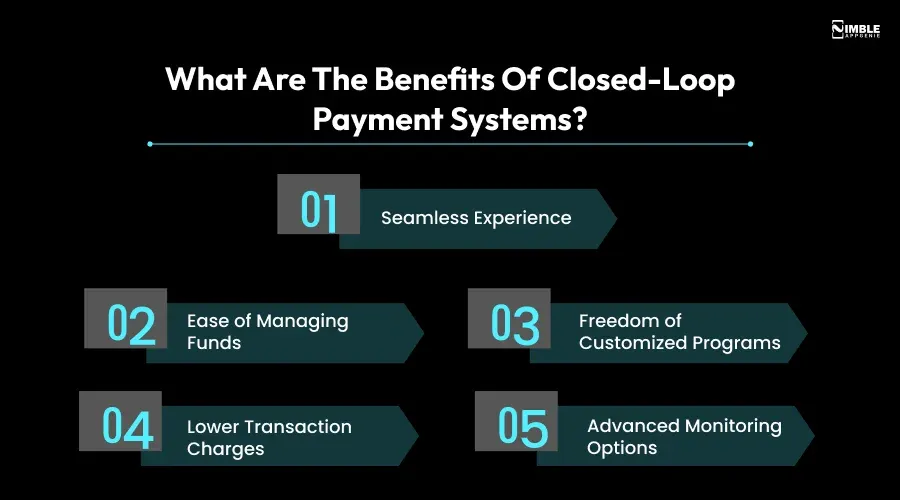
1] Seamless Experience
With a closed-loop payment system, the experience of a user becomes super-smooth as it only takes a tap to finish the transaction.
The card/e-wallet dedicated to the business is instantly recognized by the payment infrastructure available there.
2] Ease of Managing Funds
Managing your expenses and funds becomes easier when you are using a closed-loop payment system. This is because a particular mode of payment is only being used for a particular transaction. Hence, tracking those transactions and managing the funds is super simple.
3] Freedom of Customized Programs
For businesses, closed-loop payments offer a lot of freedom to introduce new reward points, cashback programs, and whatnot. Benefits like loyalty points, instant discounts, etc., are easy to implement when the payment mode is internal or closed-loop.
4] Lower Transaction Charges
For every card transaction that a user makes, businesses have to bear a charge. However, with your self-implemented payment system, you can reduce those charges to a huge extent.
A properly executed closed-loop transaction not only makes the process seamless but also makes it profitable by reducing transaction charges.
5] Advanced Monitoring Options
Tracking and monitoring the transactions also gets easier when it comes to a closed-loop payment system. That is because, unlike other payment options that accept payments from different avenues, a closed-loop payment is focused on a certain type of transaction.
Monitoring those payments is easier. Also, the entire system is set up by the business only, hence they have access to all insights on how much a consumer spends, what the patterns of transactions are, etc.
The benefits can be explored further by implementing a closed-loop payment system for your business. Implementing a closed-loop payment system can help you develop better customer relationships. Hence, it is a great investment from your business point of view.
What Technology Powers Closed-Loop Payment Systems?
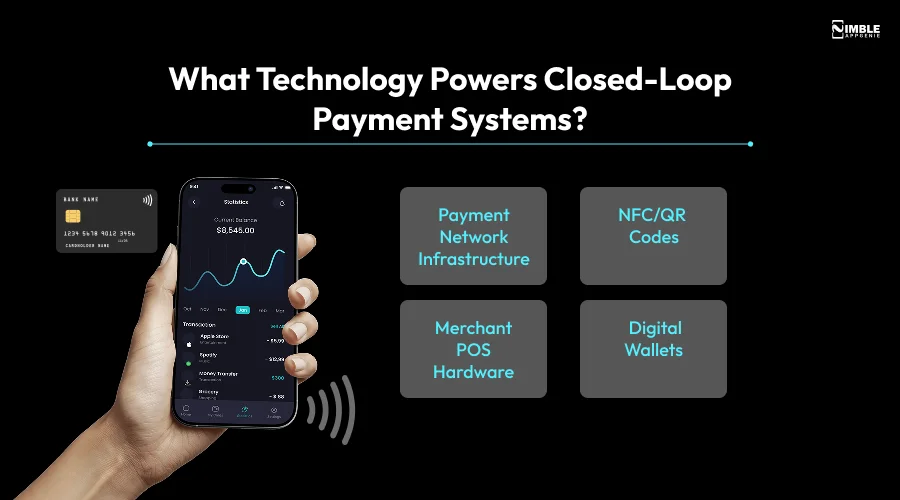
The seamless integration of APIs and robust software makes closed-loop systems a complete package for the user:
1. Payment Network Infrastructure
For any transaction to go through, a proper payment network is required – an internally developed, shared network protocol with secure servers, authentication mechanisms, and encryption.
2. Merchant POS Hardware
A combination of a custom-built gateway and hardware that serves as the physical interface for collecting payments.
3. NFC/QR Codes
To enable contactless payment, NFC payments/QR codes allow users to tap or scan to pay instantly. NFC requires tapping the terminal, while an eWallet QR code payment can work from a distance. QR codes are especially common in closed-loop setups – see our complete guide for implementation details.
4. Digital Wallets
Digital wallets offer another way to pay, needing a proper database to store information and dedicated code to make everything function.
Also read: How to Create a Digital Wallet App
What Are the Challenges in Implementing a Closed-Loop Payment System?
Building a closed-loop payment system means taking on responsibilities that open-loop card networks handle by default – fraud tooling, compliance infrastructure, and scale management. The five core challenges are manageable with the right architecture, but each requires deliberate design decisions upfront.
Let’s take a look at some of the challenges that you might encounter in implementing a closed-loop payment system:
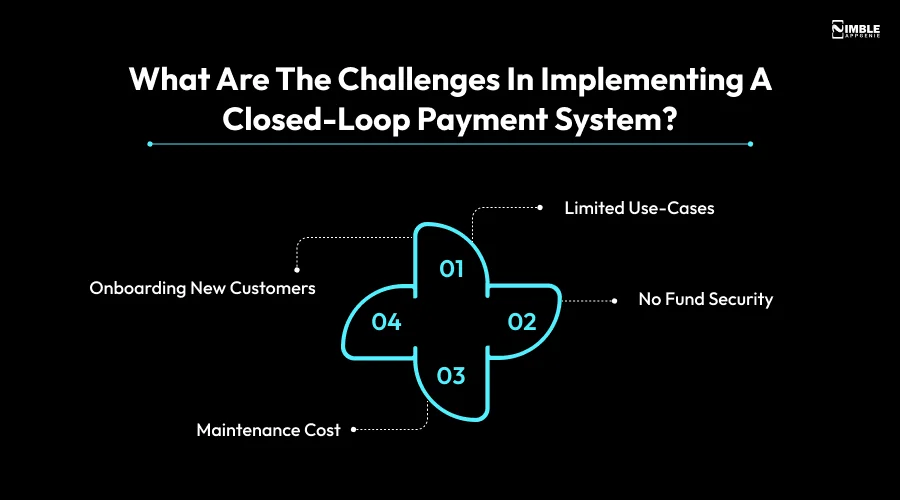
#1. Limited Use-Cases
For any closed system, the biggest challenge is to make it a priority for the user. That is because the use cases of these payment systems are very limited. The payment option is limited to only a certain network; hence, it often becomes difficult for a user to rely on it.
How to fix it:
To fix the issue of limited usage, you should allow the wallet to be used in more than one way. The same balance should work for payments, refunds, offers, and rewards. When users see a daily value, they are more likely to keep using it.
#2. No Fund Security
One of the key challenges that closed-loop payment system users face is the risk of obsolescence. That is because, unlike an open-loop payment system that allows you to use the mode of payment at different outlets, closed-loop payments only work for a specific business.
If you have added funds and the business decides to shut the system down, all your funds become useless.
How to fix it:
To avoid fund loss worries, users should always have a way to get their money back. This can be done by allowing refunds, balance transfers, or clear expiry messages. Also, to build trust, they should put some amount in their regulated accounts.
#3. Maintenance Cost
As far as businesses are concerned, the cost of implementing a closed-loop payment system often comes across as an additional cost.
Not to mention. When you set up an entire payment method, you have to ensure that the servers work properly, the system is intact, and functioning smoothly. It is often difficult to afford as the cost to build an eWallet app alone is significantly high.
How to fix it:
Maintenance costs can be kept under control by starting small. Businesses do not need all features on day one. You can use cloud systems and add features only when needed can reduce long-term cost.
#4. Onboarding New Customers
In today’s day and age, where instant payment systems have already simplified the entire process, it can become difficult for businesses to onboard new users to use the closed-loop payment system. Converting a client into a loyalty member needs several perks to be offered, which is a tough nut to crack.
How to fix it:
New users are more likely to join when the payment option is simple and useful from the start. Easy sign-up, quick checkout, and small rewards like discounts or points help users try the system without hesitation.
Other than these challenges, the fact that a closed-loop payment system requires a team to manage it is something that stops several businesses from implementing it.
Not to forget, meeting the digital payment regulations for a closed-loop payment system can be difficult.
However, these challenges can be mitigated if you have a team of professionals who can develop a closed-loop payment system for your business at a minimal cost.

How Can Nimble AppGenie Help Develop Closed-Loop Payment Solutions?
Nimble AppGenie has delivered closed-loop and open-loop eWallet solutions across retail, hospitality, and transit verticals – 350+ projects completed as of 2025, verified on Clutch and GoodFirms.
Every closed-loop build starts with a scoped use-case analysis: Nimble AppGenie maps the compliance requirements, POS integration points, and reward logic specific to the client’s market before writing a line of code, keeping development focused and cost-predictable.
Conclusion
Closed-loop payments offer unique benefits for businesses. These systems let merchants collect payments from customers inside a closed environment set up exclusively for the business, creating room for new discounts, loyalty programs, and offers that build real customer relationships.
Within the benefits and challenges laid out, and the examples corrected to reflect what’s closed-loop versus open-loop, you can choose the right payment system for your business.
Nimble AppGenie has shipped closed-loop and eWallet systems for clients across retail, hospitality, and transit – handling scoping, compliance, and phased rollout so businesses launch on schedule without reworking core architecture later.
FAQs
A closed-loop system works only within the issuer’s ecosystem, such as a Starbucks balance. An open-loop system uses shared networks like Visa or Mastercard and works at participating merchants. Nimble AppGenie builds both – see our open-loop guide for a side-by-side breakdown.
Closed-loop systems can reduce exposure to card-network data but still face risks such as stored-value fraud, account takeover, and promo abuse. Nimble AppGenie secures closed-loop wallets with controls such as device fingerprinting, velocity rules, and ATO detection.
A basic single-market wallet typically starts around $50,000, while enterprise systems with advanced rewards and POS integrations can cost more. Nimble AppGenie scopes costs based on your specific use case – contact us for an estimate.
Common industries include retail, hospitality, food and beverage, transit, gaming and entertainment, and healthcare. Nimble AppGenie develops closed-loop solutions for use cases across these categories.
Yes. Since the issuer controls the transaction ledger, rewards such as points or cashback can be credited in real time. Nimble AppGenie can integrate configurable loyalty and rewards modules into closed-loop wallets.
Requirements vary by market and use case. In the US, they can include PCI DSS, money-transmission rules, BSA/AML requirements, and escheatment laws. Nimble AppGenie incorporates compliance-focused infrastructure into closed-loop payment solutions.
A basic single-market wallet with stored value and POS integration typically takes around 4–6 months. More complex systems can take 8–12 months or longer. Nimble AppGenie uses a phased rollout approach, starting with the core wallet before adding loyalty and analytics.

Niketan Sharma, CTO, Nimble AppGenie, is a tech enthusiast with more than a decade of experience in delivering high-value solutions that allow a brand to penetrate the market easily. With a strong hold on mobile app development, he is actively working to help businesses identify the potential of digital transformation by sharing insightful statistics, guides & blogs.